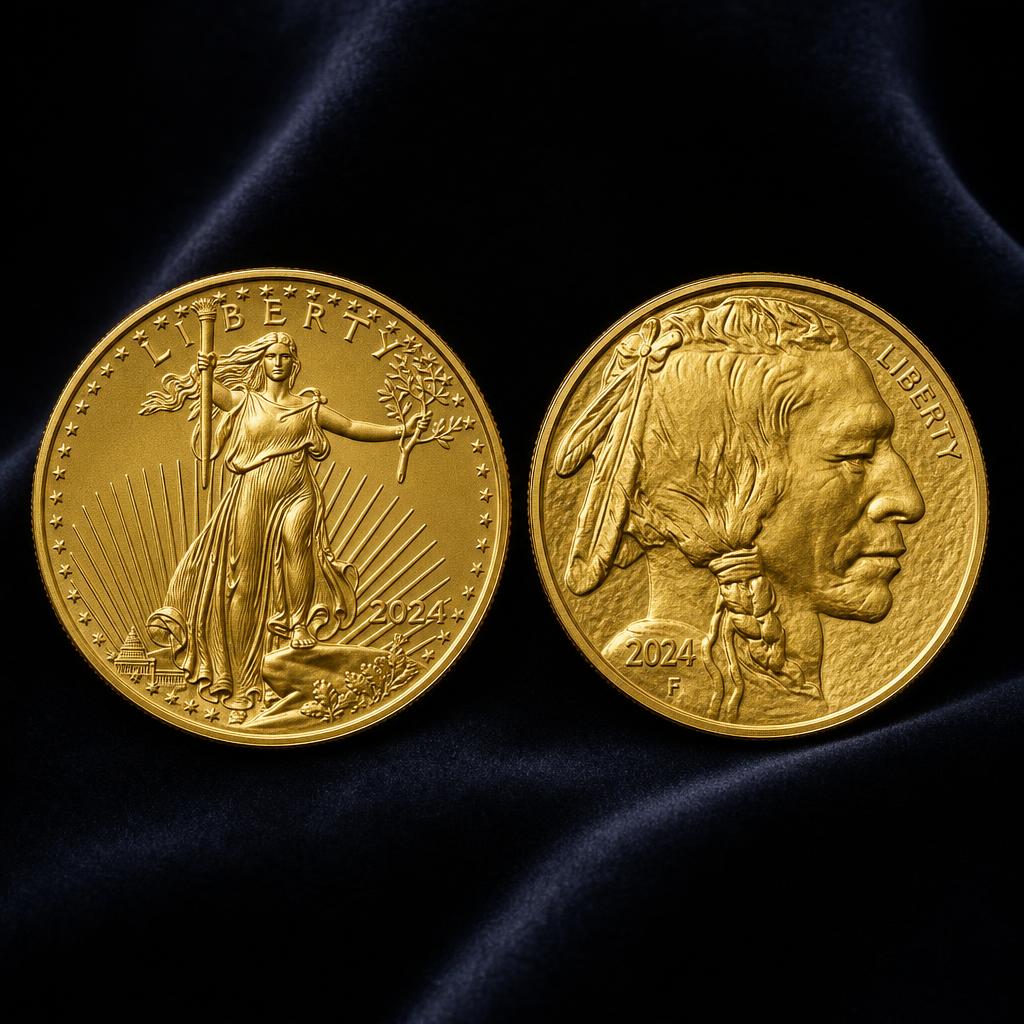
The American Gold Eagle and the American Gold Buffalo are the two flagship US Mint gold coin programs — and they're among the most commonly sold bullion coins we see in Connecticut Shoreline. Despite both being US government-issued gold coins, they differ significantly in gold purity, target market, and resale dynamics. If you're selling one or both, understanding these differences helps you know what to expect.
American Gold Eagle: The Basics
First issued in 1986, the American Gold Eagle is the US government's original bullion coin program. Key specifications:
- Purity: 22 karat / .9167 fine (91.67% gold)
- Composition: gold alloyed with silver and copper for durability
- Available sizes: 1 oz, ½ oz, ¼ oz, and 1/10 oz
- Obverse: Augustus Saint-Gaudens Liberty design (adapted from the 1907 Double Eagle)
- Legal tender: Yes, face value of $50 for the 1 oz (nominal only)
- Backing: US government guarantees weight and purity
American Gold Buffalo: The Basics
First issued in 2006, the Gold Buffalo was Congress's response to demand for a US-issued pure gold coin to compete with the Canadian Maple Leaf and Austrian Philharmonic. Key specifications:
- Purity: 24 karat / .9999 fine (99.99% gold) — the purest US gold coin ever made
- Composition: pure gold, no alloy additions
- Available sizes: 1 oz only (some fractional proofs exist but are rare)
- Obverse: James Earle Fraser's Buffalo Nickel design from 1913
- Legal tender: Yes, face value of $50 (nominal only)
- Backing: US government guarantees weight and purity
Which Has More Gold — Eagle or Buffalo?
This is the critical question for sellers. A 1 oz Gold Buffalo contains more pure gold than a 1 oz Gold Eagle:
- 1 oz Gold Buffalo: 1.000 troy oz of pure gold (.9999 fine)
- 1 oz Gold Eagle: 0.9167 troy oz of pure gold (plus silver and copper to make total weight 1.0909 oz)
- Difference per coin: the Buffalo contains ~8.33% more pure gold than the Eagle of the same face denomination
At $4,100 spot gold, a 1 oz Gold Buffalo contains roughly $340 more pure gold than a 1 oz Gold Eagle. However, both trade at premiums to their melt value — the actual difference in what you receive depends on market premiums at the time of sale.
Market Premiums and What You'll Actually Receive
Both coins trade at a premium over their gold content — the premium reflects manufacturing costs, dealer spreads, and collector demand. Gold Eagles typically carry a slightly lower premium on the buy side because they're more liquid and widely traded. Gold Buffalos carry a slightly higher premium due to their 24K purity appeal. In practice, for sellers at current market conditions, both coins pay within 1–2% of each other as a percentage of spot.
Proof vs. Bullion Coins
Proof versions of both coins — produced by the US Mint with mirror-like fields and frosted designs — carry numismatic premiums beyond their gold content. Proof Eagles and Buffalos in original mint packaging with certificates of authenticity often command 10–30% above melt value depending on the year and condition. We assess proofs separately from bullion strikes and pay the numismatic price when it exceeds melt.
Which Should You Sell First?
If you're selling both, the Gold Buffalo will typically yield slightly more per ounce in pure gold terms. However, both are extremely liquid and easy to sell — don't hold either back waiting for conditions to change if you need same-day payment now. At $4,000+ gold, both represent exceptional value for sellers.
Selling Gold Eagles, Gold Buffalos, or other bullion coins in Connecticut Shoreline? Get a free Sigma Metalytics scan and spot-price offer from Gold Buyers Connecticut — same-day payment, no pressure.